Answered by a licensed electrician
Why is my outlet reverse polarity?
Quick answer
Reverse polarity means the hot and neutral conductors are swapped at the outlet or at an upstream splice feeding it. The outlet may still power lamps and chargers, but appliance shells or internal parts can stay energized when switched off. Standard outlet or switch replacement runs $80–$120 each when correction is straightforward.
Reverse polarity means the outlet is wired backwards: the hot conductor is on the neutral side, or the neutral is tied into the hot side somewhere upstream. A plug-in tester often catches it, but the cause still has to be confirmed with a meter before anyone starts moving wires.
On a standard 120-volt receptacle in Ontario, the narrow slot is hot, the wider slot is neutral, and the round opening is the bonding path. On the device itself, the hot conductor belongs on the brass-coloured screw, the neutral on the silver-coloured screw, and the bond on the green screw or bonding terminal. If hot and neutral are reversed, the outlet can look normal and still be unsafe.
This is a common reason homeowners call for switch and outlet repair, especially after buying an older home, finishing a basement, replacing painted-over receptacles, or testing outlets during a renovation.
The most common cause is a swapped hot and neutral at the receptacle
The usual cause is simple: someone connected the black hot wire to the silver neutral terminal and the white neutral wire to the brass hot terminal. The outlet still works because a load only needs a complete path, but the safety assumptions built into plugs, switches, lamp sockets, and appliances are now wrong.
A few details matter when diagnosing it:
- The black or red conductor is normally hot, but colour alone is not proof in an altered box.
- The white conductor is normally neutral, but it can be misused or re-identified in some switch loops and older wiring.
- Backstabbed receptacle connections can be loose, hidden, or mixed up behind the device.
- Multi-wire branch circuits and shared neutrals need extra care because moving one conductor can affect another circuit.
- GFCI receptacles have LINE and LOAD terminals; reversing those is a different problem from hot-neutral reversal, and it can make downstream protection behave unexpectedly.
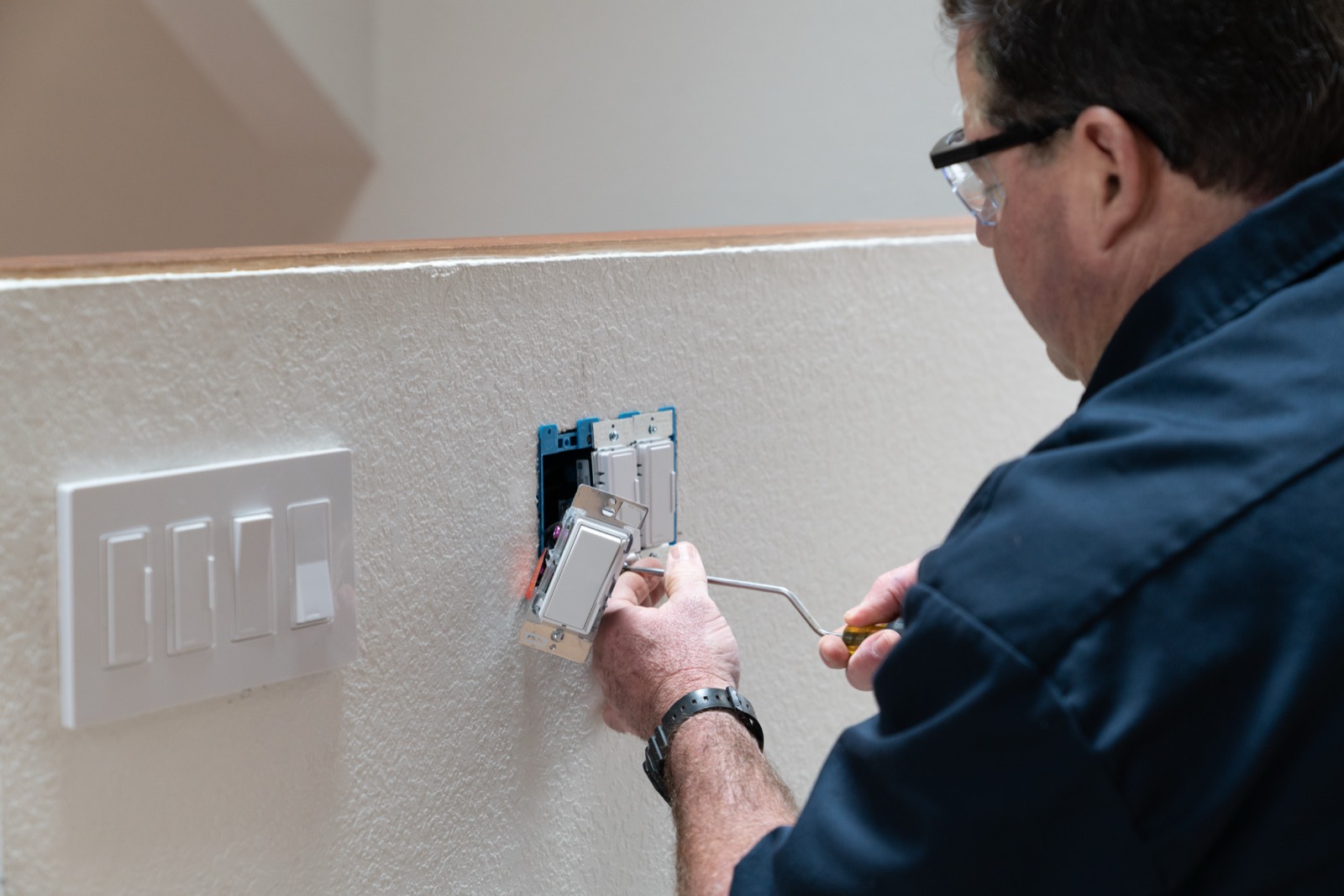
A plug tester saying “hot/neutral reverse” is a clue, not the full diagnosis. A licensed electrician will usually remove the cover, de-energize and verify the circuit, identify the feed conductors, test hot-to-neutral, hot-to-bond, and neutral-to-bond, then correct the termination. If the receptacle is old, loose, cracked, painted shut, or no longer grips plugs properly, replacement at the same visit is usually the cleanest fix.
The reversal may be upstream, not in the outlet you tested
If the receptacle itself is wired correctly, the hot and neutral may be reversed in an upstream outlet, junction box, switch box, or renovation splice. That is why fixing only the outlet with the tester reading is not always enough.
Many circuits are daisy-chained. Power enters the first box, leaves for the next, and continues around the room. If someone reversed the feed-through connection at the first receptacle, every outlet downstream can test reverse polarity even though those downstream devices are landed neatly on brass and silver screws.
We often see this after:
- A room was renovated and devices were replaced without tracing the feed.
- An older two-prong outlet was changed to a three-prong outlet without proper testing.
- A basement or addition was tied into an existing circuit.
- A junction box above a drop ceiling or in a closet was spliced incorrectly.
- A DIY repair mixed up two white conductors and two black conductors in a crowded box.
The useful question is not “which outlet failed the tester?” It is “where does the polarity first become wrong?” That requires tracing the circuit from the panel outward, finding the first bad reading, and opening boxes in order. In older Toronto and GTA houses, one wrong splice can create a string of miswired outlets across part of a room.
This is also why a home with one reverse-polarity outlet should not be treated as a one-device problem until nearby outlets are checked. Older and renovated homes can have several miswired devices, especially where previous owners added receptacles, moved walls, or finished basements over many years.
Reverse polarity is a shock and appliance safety issue, even when the outlet “works”
Reverse polarity is unsafe because it can leave parts energized that are supposed to be closer to neutral potential. The danger is not that the outlet will always spark immediately. The danger is that normal appliance design may not protect you the way it should.
A table lamp is a simple example. The switch is intended to interrupt the hot conductor. With reverse polarity, the switch may interrupt the neutral instead. The lamp turns off, but the metal screw shell inside the socket can remain energized. Someone changing a bulb could touch the shell while also touching a grounded surface.
The same principle applies to appliances and electronics with internal switching, fusing, filters, or metal parts. The equipment may operate, but the energized side is now in the wrong place. That can increase shock risk during servicing, increase stress on certain components, and make fault conditions less predictable.
| What you see | What it may mean | What to do |
|---|---|---|
| Plug tester shows hot/neutral reverse | Receptacle or upstream splice is crossed | Stop guessing and have the circuit traced |
| Several outlets in a row test reversed | The error is likely upstream of all of them | Find the first bad point on the circuit |
| Outlet works but tester flags a fault | Power flow exists, but polarity is wrong | Do not assume “working” means safe |
| Tester result changes when a load is plugged in | There may be an open neutral or loose connection too | Treat it as a diagnostic issue, not a simple swap |
Do not keep using an outlet that also sparks, smells burnt, buzzes, shows scorch marks, or has a loose plug fit. Those symptoms point to heat or arcing concerns, and the safer next step is the guidance in what to do if an outlet sparks or smells like burning. If the issue is heat at the device rather than a tester reading, see why an outlet feels warm.
Do not just swap wires until you know which conductor is actually hot
The correct fix is to identify the hot, neutral, and bond, then restore the circuit so polarity is correct at the outlet and downstream. Randomly swapping wires can create a worse condition, especially in older boxes with shared neutrals, switch loops, ungrounded wiring, or multiple cables entering the same enclosure.
A proper correction usually includes:
- Turning off the correct breaker and proving the circuit is de-energized.
- Removing the receptacle without damaging older insulation.
- Testing conductors with a meter, not only a non-contact tester.
- Confirming the bond path where a three-prong receptacle is installed.
- Checking LINE and LOAD terminals on any GFCI device.
- Testing downstream outlets after the repair.
- Replacing worn receptacles that no longer hold plugs tightly.
- Labelling or documenting any unusual circuit arrangement found in the box.
If the repair is only a like-for-like device replacement or correction inside an existing box, the work may be simple. If the diagnosis finds damaged cable, hidden junctions, missing bonding, added outlets, or new wiring that has to be installed, the scope changes and an ESA notification may be required. City Power Electrical Services is an ECRA/ESA licensed electrical contractor, and we file ESA notifications where required rather than leaving a homeowner with undocumented work.
Cost depends on whether the issue is one miswired receptacle or a circuit-tracing job through several boxes. For a straightforward device correction or replacement, use the normal outlet pricing as a guide: standard outlet or switch replacement is typically $80–$120 each, while specialty devices such as GFCI or smart controls cost more depending on the device. If the fix turns into adding or relocating an outlet, the pricing discussion is closer to the cost to add an outlet.
Check nearby outlets, GFCIs, and renovated areas before calling it solved
One corrected receptacle is not enough if the circuit has other reversed devices downstream. After the repair, every outlet on that run should be tested for correct hot-neutral orientation, bonding, and GFCI protection where required.
Bathrooms, kitchens, unfinished basements, garages, laundry areas, and outdoor locations deserve extra attention because GFCI protection is commonly involved. A GFCI can still have a polarity or LINE/LOAD problem that needs proper testing. If the reverse-polarity reading is on a bathroom or exterior circuit, it is worth checking whether the issue is mixed with a tripped or miswired GFCI. Related symptoms are covered in bathroom outlet troubleshooting and GFCI outlet installation cost if replacement is needed.
For older or renovated homes, the best approach is usually a small inspection pattern rather than a one-outlet visit: test the affected receptacle, test the outlets on both sides of the room, identify the first bad point, open only the boxes needed, correct the wiring, and then retest the full run. That catches the real source instead of making the nearest outlet look right while the upstream mistake remains.
If your tester shows reverse polarity in Toronto or the GTA, stop using that receptacle for appliances with metal housings, heaters, tools, or sensitive electronics until it is checked. A simple miswire is usually quick to correct, but only after the hot, neutral, and bond are positively identified.
Want a licensed electrician to take a look?
Free written quote, usually the same day. ESA permits handled.
People also ask
Can an outlet have reverse polarity and still work?
Yes. A lamp, charger, or small appliance may still turn on because the circuit is complete. The problem is that hot and neutral are in the wrong positions, so switches, fuses, and internal appliance parts may not be protecting the energized side the way they were designed to.
Is reverse polarity an emergency?
It is not always a lights-out emergency, but it is unsafe and should be corrected promptly. Stop using the outlet for metal-cased appliances, power tools, heaters, or electronics until it is tested. If there is burning smell, sparking, buzzing, or discolouration, turn the circuit off and call for service.
Can I fix reverse polarity by swapping the two wires on the outlet?
Only if the reversal is actually at that receptacle and the conductors have been correctly identified. If the problem is upstream, swapping wires at the tested outlet can mask the real fault or create another one. A meter test is needed to confirm hot, neutral, and bond before changing connections.
Why do several outlets show reverse polarity?
Several reversed readings usually mean the mistake is upstream of those outlets. One incorrect feed-through splice or receptacle can send reversed polarity to everything downstream. The fix is to trace the circuit back to the first bad point, correct it there, and then retest the remaining outlets.