Answered by a licensed electrician
Why is my bathroom outlet not working?
Quick answer
A bathroom outlet usually stops working because a GFCI has tripped upstream, the breaker has tripped, moisture has entered the device, or the receptacle has failed. Bathrooms are expected to have GFCI protection in Ontario. If the GFCI device needs replacement, budget $120–$180 installed including parts.
Check the GFCI first, because one tripped device can shut off several bathroom outlets
The most common reason a bathroom outlet is dead is a tripped GFCI receptacle somewhere else on the same protected circuit. In many GTA homes, one GFCI device protects the main bathroom, powder room, ensuite, and sometimes a nearby hallway or vanity outlet.
A GFCI is the outlet with TEST and RESET buttons. It monitors current leaving and returning on the circuit. If it sees leakage that could pass through water, a wet countertop, or a person, it opens the circuit quickly. That is why bathrooms require GFCI protection under Ontario electrical safety expectations.
Do not assume the dead outlet is the one with the reset button. Look in:
- The same bathroom, especially beside the sink or inside a vanity side wall
- Other bathrooms and powder rooms
- A laundry room or basement bathroom
- A nearby mechanical room or unfinished basement wall
- The electrical panel, if the protection is built into a GFCI breaker
To reset a GFCI receptacle, press RESET firmly until it clicks. Some devices will not reset unless power is present, so if the reset button feels loose or will not latch, check the breaker next.
If the bathroom outlet works after a reset, plug in only one appliance and test again. A hair dryer with a damaged cord, an electric toothbrush charger sitting in water, or a wet shaver plug can trip the device immediately. If the GFCI trips again with nothing plugged in, the fault is likely in the wiring, the receptacle, or moisture inside the box.
For whole-home outlet problems that are not limited to the bathroom, see why outlets stop working when the breaker is not tripped. Bathroom faults are narrower because the GFCI and wet-location risk change the diagnosis.
Check the breaker once, because a bathroom circuit may trip without looking obvious
The breaker may be tripped even if the handle does not sit dramatically in the middle. Push the suspect breaker fully to OFF, then back to ON once. Do not keep resetting it if it trips again.
Bathroom circuits often see short, heavy loads. Hair dryers, curling irons, straighteners, bidet seats, towel warmers, and portable heaters can all pull significant current. If two high-load devices are used at the same time, the breaker may trip even though the outlet itself is not defective.
Use this quick separation:
| Symptom | Likely cause | What to do |
|---|---|---|
| Outlet dead, GFCI reset restores it | GFCI did its job | Test the appliance and keep the area dry |
| GFCI will not reset anywhere | No power, failed GFCI, or downstream fault | Check breaker once, then call if it will not hold |
| Breaker trips when hair dryer starts | Overload or appliance fault | Try a different bathroom circuit; do not use extensions |
| Outlet works, then fails after showering | Moisture or condensation | Stop using it until opened and tested |
| Only the top or bottom half is dead | Split receptacle issue or failed device | Have the outlet tested and replaced if needed |
A key bathroom safety point: do not run an extension cord for a hair dryer, heater, or grooming appliance because the outlet is dead. Extension cords are easy to splash, overload, or pinch under a vanity door. Portable heaters and bathroom cords are an especially bad mix.
If the breaker trips instantly with everything unplugged, leave it off. That points to a wiring fault, failed receptacle, wet box, or damaged cable. Repeated resetting can worsen arcing or heat damage before anyone has opened the box.
Moisture matters, because bathrooms can damage outlets without flooding
A bathroom outlet can fail from ordinary moisture: steam from showers, splash from the sink, damp tile cleaning, or condensation inside a cold exterior wall. You do not need a visible flood for a GFCI to trip or a receptacle to corrode.
Moisture-related clues include:
- The outlet dies after long showers but works later
- The faceplate feels damp or has mineral marks around the edges
- The GFCI trips when a plug is inserted, not when the appliance is switched on
- There is rust on the mounting screws or greenish staining on copper parts
- The outlet is beside a sink but the cover plate does not sit tight to the wall
- A vanity drawer or cabinet back rubs the plug and loosens it over time
If water may have entered the box, do not remove the cover while the circuit is energized. Turn off the breaker if you can identify it safely, and avoid using that outlet until it is opened, dried, and tested.
Moisture can also expose older workmanship. We often see bathroom receptacles fed through small boxes crammed with line and load conductors, backstabbed connections, old GFCI devices that no longer trip cleanly, or splices hidden behind vanities from past renovations. Those are not just nuisance problems; they affect whether the GFCI can protect the downstream bathroom outlet.
Outdoor outlets have similar GFCI and moisture issues, but the failure points are different: in-use covers, weatherproof boxes, and exterior cable entries. If your issue is outside rather than at the vanity, read why an outdoor outlet is not working.
Replace or repair the receptacle when the GFCI, breaker, and moisture checks do not solve it
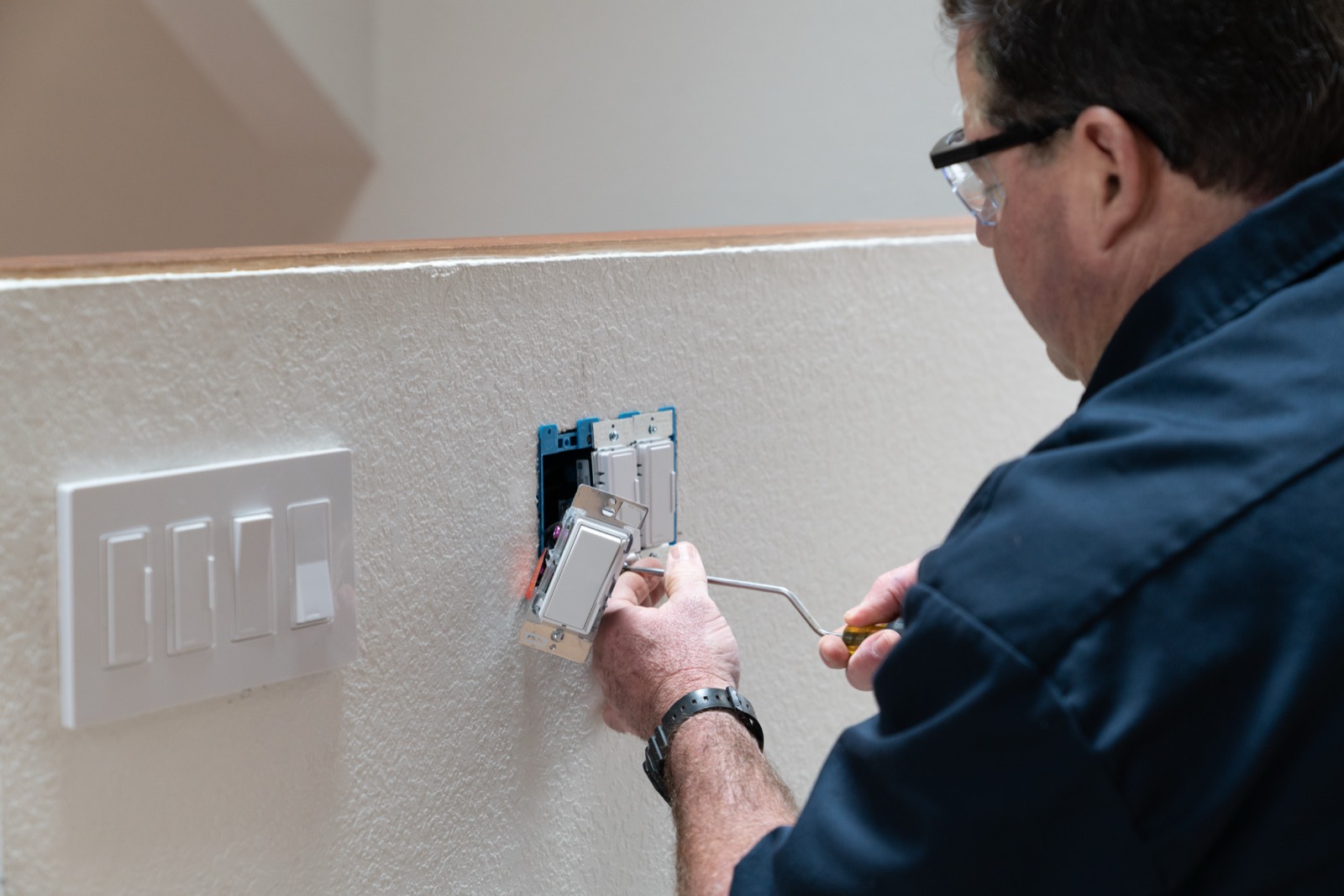
If power is present in the box but the bathroom outlet will not work, the receptacle or its connections may have failed. A licensed electrician will test line voltage, confirm polarity and grounding, identify line and load on the GFCI, and verify that the downstream protection works after the repair.
Common bathroom outlet defects include:
- A failed GFCI mechanism that will not latch or trip correctly
- Line and load wires reversed after a previous replacement
- Loose terminal screws or backstabbed conductors that no longer make solid contact
- Corroded conductors from damp air behind a vanity
- A broken neutral feeding downstream outlets
- A standard receptacle installed where GFCI protection is required
- An oversized faceplate hiding a loose box or damaged drywall opening
If the outlet has been replaced before and never worked correctly, polarity is worth checking. A miswired receptacle can appear to work for a simple lamp but still be unsafe for bathroom use. See why outlet reverse polarity matters if a plug-in tester shows hot/neutral reversed.
For cost planning, a bathroom GFCI replacement is usually in the $120–$180 range when supplied and installed. A basic switch or receptacle replacement is typically $80–$120 each, while smart devices, timers, USB-C combinations, and other specialty devices are usually $120–$250 installed depending on the device and wiring. If the problem requires fishing new cable, adding a dedicated bathroom circuit, or correcting unpermitted renovation wiring, it should be quoted in writing after a site visit.
City Power Electrical Services is a Licensed Electrical Contractor, ECRA/ESA #7015314, and for bathroom outlet repairs we provide a written estimate, file ESA notification where required, test the GFCI protection, and clean up before leaving.
For repair or replacement, start with our switches and outlets service. If you are considering adding another receptacle near a vanity or in a renovated bathroom, compare the scope in how much it costs to add an outlet.
Call an electrician when reset steps do not restore safe power
You should call when the GFCI will not reset, the breaker trips again, there is moisture inside the box, the outlet is loose, or any appliance gives a shock or tingling sensation. Bathroom outlets are not the place to experiment because wet skin lowers resistance and a small wiring fault can become serious.
Call promptly if you notice:
- No bathroom outlets work after checking all GFCIs and the breaker
- The GFCI reset button pops out immediately with nothing plugged in
- The outlet crackles, sparks, smells burnt, or has a discoloured faceplate
- The device is loose in the wall or plugs fall out
- The outlet is near a sink but is not GFCI protected
- The problem started after a vanity, tile, fan, bidet, or bathroom renovation
- You are using extension cords because the bathroom outlet is unreliable
An electrician will usually isolate the fault by testing at the panel, the first GFCI device, and the dead receptacle. If the bathroom is fed through another bathroom, the upstream GFCI must be wired correctly so every downstream receptacle is protected. If there is no equipment ground, damaged cable, or hidden junction, the fix may be more than a device swap.
The final test matters. After repair, the GFCI should trip with its test button, reset cleanly, show correct polarity, and cut power to every downstream bathroom receptacle it protects. That is the difference between getting the outlet working and making it safe to use beside a sink.
Want a licensed electrician to take a look?
Free written quote, usually the same day. ESA permits handled.
People also ask
Can a bathroom outlet stop working because of another bathroom?
Yes. One GFCI in a main bathroom, ensuite, powder room, basement bathroom, or even at the panel can protect several bathroom receptacles. If one outlet is dead, check every GFCI in the home before replacing the device. The upstream GFCI may have tripped and removed power from the bathroom you are using.
Why will my bathroom GFCI not reset?
A bathroom GFCI will not reset if it has no incoming power, the device has failed, the breaker is off, or there is a downstream ground fault. Some GFCIs also refuse to latch when line and load are reversed. If it will not reset after checking the breaker once, stop using the outlet and have it tested.
Is it safe to use a non-GFCI outlet in a bathroom?
No. Bathroom receptacles are expected to be GFCI protected because water, wet skin, metal plumbing, and high-wattage grooming appliances raise the shock risk. If your bathroom has a standard outlet with no GFCI protection at the receptacle or breaker, have it upgraded and tested by a licensed electrician.
Can I use an extension cord in the bathroom until the outlet is fixed?
Do not use an extension cord for a bathroom hair dryer, heater, curling iron, or similar appliance. Cords can be splashed, overloaded, pinched by vanity doors, or used outside GFCI protection. If the bathroom outlet is dead, use another properly protected bathroom circuit temporarily and book the repair.