Answered by a licensed electrician
Why is my wall plate discoloured?
Quick answer
A discoloured wall plate is most concerning when the mark is brown, black, melted, or centred around the plug slots or switch. Turn off that circuit if there is heat, burning odour, buzzing, crackling, or scorch marks. Standard switch or outlet replacement typically runs $80–$120 each when the wiring behind it is sound.
A discoloured wall plate can be harmless aging, but treat it as electrical heat damage until you prove otherwise. Brown staining around a receptacle slot, a dark halo above a switch, bubbling plastic, or a smoky smell means the device may be overheating or arcing inside the box. Do not keep using it to “see if it happens again.”
City Power Electrical Services handles 24/7 emergency calls in Toronto and the GTA, and our licensed electrical contractor number is ECRA/ESA #7015314.
Turn off the circuit if there is heat, odour, melting, or scorch marks
Turn off the breaker now if the plate is warm, smells burnt, has black or brown scorch marks, is cracked from heat, or you hear sizzling or crackling. Unplug anything connected to that outlet first if it is safe to touch the cord, then switch the breaker off. If the plate or plug is too hot to touch, do not handle it; shut the breaker off at the panel.
The risk is not the cosmetic stain. The risk is the damaged connection behind the wall plate: a loose terminal, a tired receptacle, an overloaded device, or arcing that has started to carbonize the plastic. Carbon tracking can make a fault worse because scorched material can become more conductive over time.
Use this quick triage:
| What you see or smell | What to do |
|---|---|
| Light yellowing on an old plastic plate, no heat, no smell | Clean and monitor, but replace the plate if brittle |
| Dust or grey staining above a switch, no heat | Less urgent; often airflow and dirt, but check if it returns quickly |
| Brown mark around one plug slot | Stop using it and have the receptacle opened and tested |
| Black mark, melted plate, burnt odour, buzzing, or crackling | Turn off the breaker and call an electrician |
| Discolouration after using a heater, kettle, microwave, or portable AC | Leave it off until the device and circuit are checked |
Do not tape over the outlet, spray cleaner into it, or replace only the plastic cover and assume the problem is gone. The visible plate is just the cover. The failure usually sits at the device screws, back-wire clamp, push-in connection, splice, or plug contact behind it.
If the outlet itself is warm as well, see why an outlet feels warm. If the mark is at a switch and the switch feels hot, see why a light switch gets hot.
The most serious causes are loose connections, arcing, and overloaded devices
A heat-stained wall plate usually points to resistance at a connection, not heat coming from the wall itself. Electricity should pass through tight metal-to-metal contact. When that contact loosens, the same load has to squeeze through a smaller or unstable contact point, creating heat.
Common causes include:
- Loose side terminal screw: The wire is under the screw, but not clamped tightly enough. Normal use and thermal cycling can worsen it.
- Backstabbed receptacle connection: Some older receptacles used push-in back connections. They can loosen with age or heavy use.
- Worn plug contacts: If plugs feel loose, the receptacle’s internal spring contacts may not grip firmly, causing heat at the blade.
- Overloaded receptacle or switch: A high-draw appliance on a tired outlet can expose weak contacts quickly.
- Wrong device for the load: A dimmer, timer, receptacle, or switch must be rated for the load it controls.
- Poor splice in the box: The wall plate may stain even if the actual hot spot is a wire connector tucked behind the device.
- Aluminum branch wiring: Older aluminum wiring needs approved terminations or pigtails; ordinary copper-only devices are not acceptable for aluminum conductors.
- Moisture or corrosion: In kitchens, bathrooms, garages, and exterior walls, corrosion can increase resistance and create heat.
Arcing is especially urgent. Instead of a steady connection, electricity jumps across a gap. You may hear faint crackling, see intermittent flicker on the load, smell a sharp burnt-plastic odour, or find tiny black pits on the device once it is removed. An arc can occur inside the box before a breaker trips, especially if the current is not high enough to create an overload.
Breakers protect wiring from overcurrent, but they do not make a loose outlet safe. A 15A or 20A breaker can stay on while a bad connection at one receptacle gets hot enough to discolour the plate. That is why a stained plate deserves a physical inspection, not just a breaker reset.
Dirt, UV, and age can discolour a plate, but the pattern matters
Uniform yellowing is usually less urgent than localized browning. Plastic plates can yellow from sunlight, age, kitchen grease, cigarette smoke, candles, incense, and dust carried by air movement through the wall cavity. In older homes, you may see a grey “ghosting” pattern above switches where warm air leaks around the box and deposits dust on the wall and cover.
Harmless-looking patterns usually have these traits:
- The entire plate is evenly yellowed.
- The discolouration is strongest on plates exposed to sunlight.
- The mark wipes off as dust or grease.
- There is no heat, odour, crackle, looseness, or staining around the plug slots.
- Nearby non-electrical plastic items show similar fading.
Heat patterns are different. They tend to be concentrated around one receptacle slot, one switch screw area, the top edge of a dimmer, or the centre of the device. The plastic may look glossy, warped, brown, or brittle. A hot plug may leave a matching mark on the cord cap. A cover screw may be darkened because heat is transferring through the device yoke.
A dimmer can add confusion because some dimmers run slightly warm in normal operation. But a dimmer should not melt a plate, produce a burnt smell, or darken the wall. If the switch controls LED fixtures, the dimmer also has to be compatible with that LED load; incompatible dimmers can buzz, flicker, and overheat. For switch-specific symptoms, read why a light switch is hot.
If you are unsure, err on the side of turning the circuit off. Cosmetic staining can wait; heat damage should not.
An electrician should open the box, test the device, and replace damaged parts
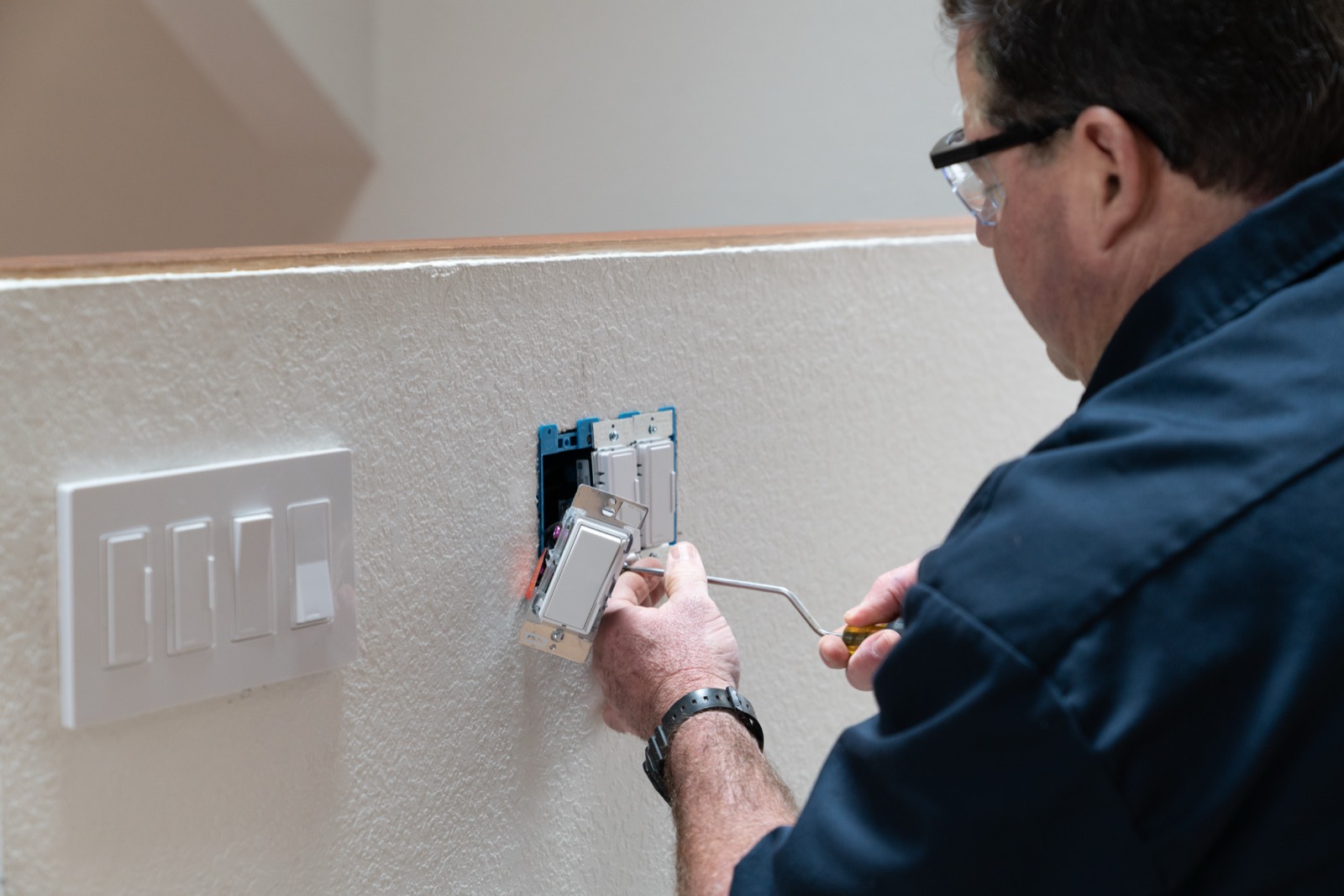
The proper repair is to inspect the wiring inside the box, not just replace the faceplate. With the circuit verified off, an electrician removes the cover and device, checks conductor condition, looks for melted insulation, confirms the device rating, and tests for loose or overheated connections.
On a discoloured receptacle or switch, we commonly check:
- Whether the breaker size matches the branch-circuit wiring.
- Whether the receptacle is 15A or 20A and appropriate for the circuit.
- Whether copper or aluminum conductors are present.
- Whether any conductor insulation is brittle, scorched, or nicked.
- Whether the device was backstabbed, side-wired, or clamped properly.
- Whether wire connectors in the box show heat damage.
- Whether the box has enough space for the conductors and device.
- Whether grounding is present and continuous.
- Whether nearby outlets on the same circuit show similar heat or looseness.
The repair might be simple: replace the receptacle or switch, cut back a damaged conductor if there is enough length, remake the termination, install a new wall plate, and test under load. Standard outlet or switch replacement is usually in the $80–$120 each range when the box and wiring are otherwise sound. A GFCI outlet is usually $120–$180 installed, and specialty devices such as smart dimmers or timers are commonly $120–$250 depending on the device.
If the conductor insulation is heat-damaged deep into the box, if the box is too small, if aluminum wiring needs approved remediation, or if a new dedicated circuit is required for the appliance being used there, the work should be quoted in writing after a site visit. Any ESA notification required for the scope should be filed, and the work should be inspected where required.
For device replacement and troubleshooting, book switch and outlet repair. If the discolouration appeared with breaker noise, heat, or repeated trips, also read why a breaker is buzzing, because the problem may not be limited to the wall box.
Do not keep using a discoloured outlet for high-draw appliances
Stop using the outlet until it is checked if the discolouration appeared while running a heater, kettle, toaster oven, microwave, portable air conditioner, dehumidifier, hair dryer, or power bar. These loads draw enough current to expose a weak receptacle quickly. The appliance may be fine; the wall connection may be the weak point.
A common pattern is an old receptacle that still “works” for a phone charger or lamp but heats up when a 12A appliance runs for a while. Another is a loose plug that droops out of the outlet. That poor blade contact can create heat at the face of the receptacle and leave a brown crescent around one slot.
Avoid these temporary fixes:
- Do not use an extension cord to move the same load to another outlet on the same overloaded circuit.
- Do not plug a space heater into a power bar.
- Do not replace a 15A receptacle with a different device to “make it stronger.”
- Do not reset a breaker repeatedly if it trips after the outlet heats.
- Do not ignore a burnt smell just because the lights still work.
If one room has lost power after the plate discoloured, leave the circuit off and check why one room lost power. A failed receptacle can interrupt downstream outlets, especially where the circuit feeds through the device instead of using proper pigtails.
A discoloured wall plate is one of those electrical clues that is easy to dismiss because the device still operates. The safe move is simple: if there is any heat, odour, melting, arcing sound, or blackening, shut the circuit off and have the device opened, tested, and repaired before using it again.
Want a licensed electrician to take a look?
Free written quote, usually the same day. ESA permits handled.
People also ask
Can I just replace the discoloured wall plate?
Only if you are confident the mark is dirt, UV yellowing, or age and there is no heat, odour, melting, buzzing, or staining around the device openings. If the mark is brown or black near the plug slots or switch, replacing the cover hides the evidence without fixing the loose connection or arcing behind it.
Why is the wall plate brown around only one outlet slot?
A brown mark around one slot usually means heat at that blade contact. The receptacle may be worn, the plug may have been loose, or the conductor termination behind the receptacle may be overheating. Stop using that outlet and have it inspected; a breaker may not trip for this kind of localized resistance heating.
Is a yellow wall plate dangerous?
Even yellowing across the whole plate is often aging, sunlight, grease, smoke, or dust. It becomes a safety concern when the colour is localized, darker near a switch or outlet opening, paired with a burnt smell, or the device feels warm. When in doubt, turn the circuit off and have the box opened.
How much does it cost to fix a heat-damaged outlet or switch?
If the wiring is sound, replacing a standard outlet or switch is typically $80–$120 each. GFCI outlets usually run $120–$180 installed, and smart dimmers, timers, or other specialty devices are commonly $120–$250. Damaged wiring, aluminum conductors, or new circuit work should be quoted in writing after inspection.