Answered by a licensed electrician
How much does it cost to move an electrical panel?
Quick answer
Moving an electrical panel is quoted in writing after a site visit because the cost depends on clearance, service entrance location, meter base work, and how many branch circuits must be extended. If the move is combined with a 100A-to-200A upgrade, that upgrade scope typically runs $3,200–$4,500 including the ESA permit and inspection.
Panel relocation is quoted after seeing the panel, meter, and circuit routes
A panel move is not priced like swapping a switch or adding one outlet. The electrician has to see where the service enters the house, where the hydro meter sits, how the branch circuits leave the panel, and whether the new location has the working clearance required by the Ontario Electrical Safety Code.
That is why the honest answer for move electrical panel cost is: quoted in writing after a site visit. Two homes can look similar from the outside and have completely different electrical work behind the drywall.
The biggest cost drivers are:
- Distance from the old panel to the new panel location. A move to the other side of the same wall is very different from moving it across a finished basement.
- Whether the meter base and service entrance must move. If the outside meter and incoming service conductors stay where they are, the job is usually simpler. If the meter base, mast, conduit, or underground service route changes, the utility becomes part of the schedule.
- How many branch circuits need extension. Every lighting, receptacle, appliance, furnace, AC, EV, dryer, stove, and basement circuit that currently lands in the panel must be re-routed, spliced in approved junction boxes, or replaced.
- Wall and ceiling finishes. Open joists and unfinished utility rooms are faster. Finished basements, plaster, tiled laundry rooms, and built-ins add access and repair planning.
- Whether the panel is also being upgraded. If the equipment is old, full, damaged, or undersized, the move may be best handled as part of a panel upgrade instead of paying labour twice.
For comparison, a 100A-to-200A service upgrade in the GTA is commonly in the $3,200–$4,500 range when it includes the panel, labour, ESA notification, and inspection. Moving a panel may be less, similar, or more depending on how much rewiring and utility work is involved, so it needs its own site-specific quote.
The new panel location must satisfy clearance, access, and service layout rules
The new location has to be a legal serviceable location, not just a convenient blank wall. The panel needs clear working space so the cover can open, breakers can be operated, and a licensed electrician can work safely without climbing over storage, appliances, or a laundry sink.
In practice, we are looking for a dry, accessible area with a clear floor space in front of the panel, enough headroom to work safely, and no permanent obstruction blocking the panel door. A panel should not be hidden behind a finished cabinet, tucked inside a closet packed with storage, boxed behind drywall, or placed where plumbing leaks are likely to drip into it.
Common relocation problems include:
| Proposed location | Why it may fail |
|---|---|
| Under a water line or near a sump discharge | Moisture risk and corrosion risk at energized equipment |
| Inside a tight storage closet | Not enough working clearance or reliable access |
| Behind a finished basement wall with no service space | Future inspection and repair access becomes poor |
| Far from the meter with no practical cable route | Service conductors may need a different design |
| In a tenant area without access for the owner | Access issues for service, emergencies, and utility work |
Service entrance layout matters too. The panel is normally tied closely to the service conductors coming from the meter base. Moving the panel farther away can require service equipment changes, approved raceways, disconnect placement considerations, and sometimes a different meter/service arrangement. If the existing panel location is wet or corroded, read why an electrical panel gets wet before assuming the fix is only cosmetic.
For basement renovations and second-suite work, location can be even more important. The panel may need to remain accessible without entering a private bedroom or locked tenant space. If the relocation is part of a second-unit plan, the electrical budget and code scope are closer to basement apartment electrical work than a simple panel swap.
Circuit extensions are often the labour-heavy part of the job
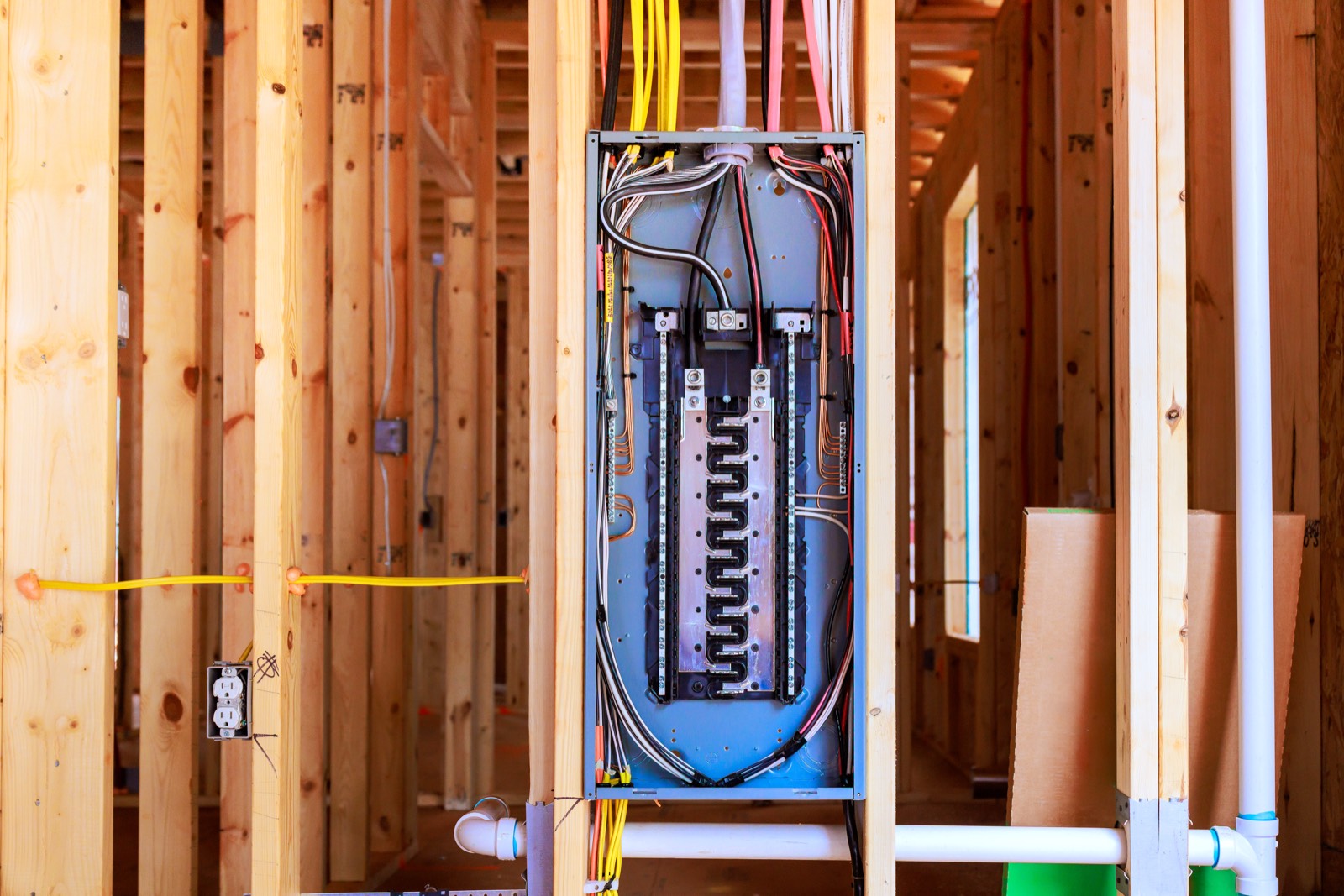
Most of the labour in a panel move is not the metal panel itself. It is the careful extension and re-termination of every circuit that used to enter the old panel.
When a panel moves, the existing cables are often too short to reach the new location. They cannot be buried in the wall with hidden splices. Any splice has to remain in an approved, accessible junction box, or the circuit must be replaced back to a practical point. That is where finished basements and older homes become more involved.
A panel relocation can involve:
- Labelling and tracing existing circuits before disconnection.
- Removing obsolete or unsafe wiring methods discovered at the old panel.
- Installing accessible junction boxes where existing cables are extended.
- Re-routing larger appliance circuits such as dryer, range, AC, hot tub, or EV circuits.
- Correcting bonding and grounding at the new service equipment.
- Replacing damaged breakers, improper double taps, or mismatched panel parts if found.
- Coordinating AFCI or GFCI protection where the renovation scope triggers current requirements.
Large circuits deserve special attention. A stove, dryer, EV charger, hot tub, or detached-garage feeder may use heavier cable that is harder to extend neatly. If one of those circuits already takes a difficult path through finished walls, it can become a major part of the relocation scope.
This is also the point where diagnosis sometimes matters. If the reason for moving the panel is nuisance tripping, heat, damaged breakers, or unknown circuits, it may be better to start with electrical diagnosis before designing the relocation. Moving a problem panel without identifying overloaded or damaged circuits can carry the same fault into the new location.
ESA and the utility are part of the schedule, not optional extras
A panel relocation requires ESA notification and inspection where required, and utility coordination is needed whenever service conductors must be disconnected or reconnected. This is not a job for a handyman or a renovation crew to “rough in” around.
The usual sequence is:
- Site visit and written scope.
- Confirm the new panel location and service route.
- File the ESA notification where required.
- Coordinate disconnect/reconnect with the local utility if the service must be de-energized.
- Move or replace the panel, extend circuits, and complete grounding/bonding work.
- Restore power once the installation is safe and approved for reconnection.
- Complete ESA inspection and correct any listed defects.
Depending on the address, the utility may be Toronto Hydro, Alectra, Hydro One, Elexicon, Oshawa Power, Oakville Hydro, Burlington Hydro, or another local distributor. Their role matters if the meter has to be pulled, a service mast is changed, overhead service conductors are altered, or underground service equipment is touched.
ESA inspection typically focuses on the things that make the installation safe and maintainable: panel location, clearances, conductor sizing, breaker sizing, grounding and bonding, cable protection, junction box accessibility, service equipment, labelling, and whether the work matches the filed scope. If the move is part of a renovation, the inspector may also look at new circuits, receptacle spacing, smoke/CO wiring, or kitchen and laundry requirements connected to the same project.
City Power Electrical Services is an ECRA/ESA licensed electrical contractor (#7015314), and for panel relocation work we provide a written estimate before the job and file ESA notification where required.
Moving the panel is often the right time to upgrade it
If the panel is already being disconnected, opened, and reworked, it is the natural time to decide whether keeping the same capacity makes sense. The added labour of moving old equipment can be hard to justify if the panel is full, obsolete, poorly labelled, or too small for planned loads.
Panel relocation often overlaps with:
- A 100A-to-200A service upgrade for EV charging, heat pumps, additions, or finished basements.
- Replacing a 60A fuse service, which commonly involves more service entrance and meter base work.
- Adding a sub-panel for a garage, workshop, basement apartment, or mechanical room.
- Reorganizing overloaded panels with too many tandem breakers.
- Creating space for future dedicated circuits, surge protection, generator interlock equipment, or EV load management.
The decision is usually practical: if you are paying to coordinate the utility, open walls, extend circuits, and pass ESA inspection, it can be more efficient to complete the capacity upgrade at the same time. A 100A-to-200A upgrade is typically $3,200–$4,500 in the GTA, while upgrading from a 60A fuse panel is commonly $4,000–$6,000 because service entrance and meter equipment often need replacement too.
A relocation is not always an upgrade, though. Sometimes the existing service size is fine, and the real goal is to get the panel out of a bathroom, closet, future bedroom, leaky corner, or demolished wall. In those cases, the quote should separate the relocation work from optional service upgrades so you can decide clearly.
If you are comparing options, ask for the estimate to show:
- Existing service size and proposed service size.
- Whether the meter base or service mast changes.
- Whether the utility disconnect/reconnect is required.
- How branch circuits will be extended and where junction boxes will remain accessible.
- Whether drywall opening and patching are included or excluded.
- ESA notification and inspection scope.
That level of detail is what makes a panel relocation quote useful. The lowest number is not helpful if it leaves hidden splices, blocked access, no ESA record, or a panel that has to be moved again during the next renovation.
Want a licensed electrician to take a look?
Free written quote, usually the same day. ESA permits handled.
People also ask
Can I move an electrical panel a few feet myself?
No. A panel contains service equipment and many branch circuits, and the work normally requires ESA notification and inspection. Even a short move can involve service conductors, grounding, bonding, accessible splices, and utility coordination. A licensed electrical contractor should design and complete the move.
Is it cheaper to move a panel or upgrade it in the same place?
Usually, leaving the panel in place is cheaper because the branch circuits and service entrance already land there. Moving it adds circuit extensions, access work, and sometimes utility involvement. If the panel also needs more capacity, combining the move with a 200A upgrade may be more efficient than doing two separate projects.
Do I need Toronto Hydro or another utility to move my panel?
You need the utility when the service must be disconnected, the meter must be pulled, or the service entrance equipment changes. If only branch circuits are being reworked downstream of the service equipment, utility involvement may be limited. The site visit determines which applies.
Can the panel be moved during a basement renovation?
Yes, but it should be planned early. The new panel location must stay accessible, dry, and code-compliant after framing, laundry, storage, and finished walls are installed. If the basement is becoming a legal second unit, access, smoke/CO wiring, dedicated circuits, and service capacity all need to be reviewed together.