Answered by a licensed electrician
Why do LED bulbs glow when off?
Quick answer
LED bulbs glow when off because their drivers can light from tiny leakage current through a dimmer, smart switch, long cable run, or no-neutral switch loop. It is often harmless, but if the switch is miswired or incompatible, replace it. Standard switch replacement is typically $80–$120 each; smart dimmers are usually $120–$250 installed.
LED bulbs can glow after you turn them off because they need very little current to produce visible light. An incandescent bulb ignores that tiny current. An LED lamp may store it in the driver capacitor, then release it as a faint glow, pulse, or slow flash.
Most cases are not a fire emergency. They are usually an LED compatibility problem at the switch, not a dangerous amount of power at the fixture. The fix may be as simple as changing the bulb, but it can also point to a missing neutral, an old dimmer, or a switch that was installed in a way the LED driver does not like.
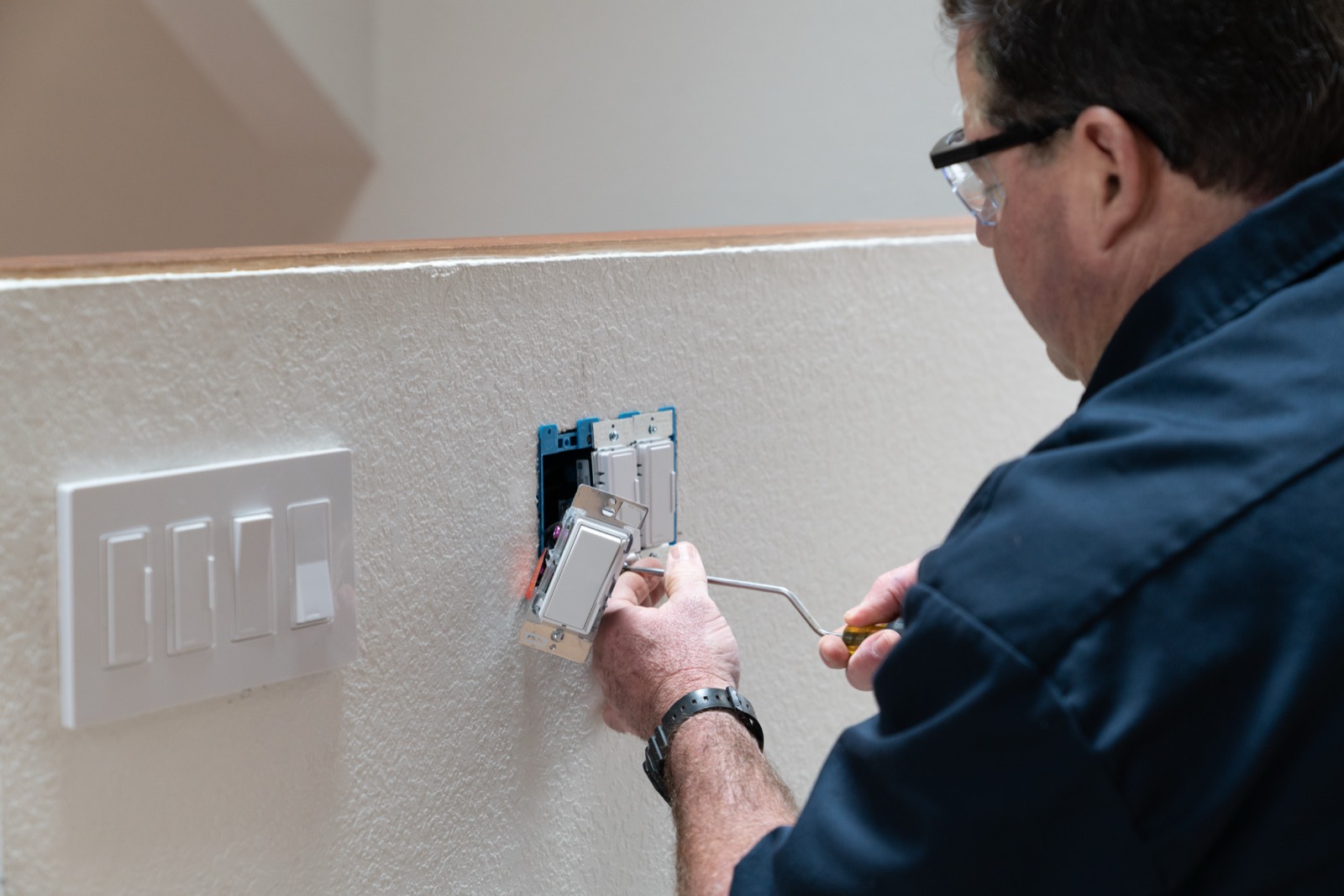
If you want the switch and bulb checked instead of guessing, our switch and outlet electricians can test the box, identify the neutral situation, and install an LED-rated replacement where needed.
The most common cause is tiny current passing through a dimmer or smart switch
Many dimmers and smart switches are never fully “off” in the same way a simple mechanical switch is off. They have electronics inside that need a small standby current for the indicator light, wireless radio, memory, motion sensor, or dimming circuit.
That standby current often travels through the light fixture when there is no neutral in the switch box. With old incandescent bulbs, the current was too small to heat the filament. With LEDs, it can be enough to charge the driver and make the bulb glow.
This is especially common with:
- older rotary or slide dimmers that were built for incandescent loads
- smart switches installed in older switch loops with no neutral conductor in the box
- illuminated switches with a locator light
- motion, timer, or occupancy switches that power themselves through the load
- low-wattage LED bulbs on a dimmer that requires a higher minimum load
- multi-way switching where one device is electronic and the other is conventional
The wording on the dimmer matters. “LED compatible” is not just marketing. LED-rated dimmers are designed for the lower wattage, different inrush current, and driver behaviour of LED lamps. Some also require a neutral. Others are made as no-neutral models, but they may need a bypass device at the fixture or a minimum connected load to stop ghosting.
A good diagnosis starts with the switch box, not just the bulb. We test whether a neutral is present, confirm which conductor is the line and which is the switched leg, and check whether the dimmer is rated for the installed lamps. If the switch is wrong for the load, replacing it is usually cleaner than trying random bulbs.
For cost context, a standard switch replacement is usually in the $80–$120 range per device, while specialty devices such as smart dimmers, timers, USB-C combinations, and GFCI-style controls commonly land between $120 and $250 installed depending on the device and wiring conditions.
It can also be induced voltage from nearby wires, not a failed bulb
A faint LED glow can come from induced voltage when long cable runs sit beside energized conductors. The switched conductor to the light is off, but it runs through the same cable or conduit path as live conductors. A small voltage can be capacitively coupled onto the off conductor.
This is most noticeable with:
- long hall, stair, or basement lighting runs
- three-way and four-way switching with travellers running between boxes
- multiple lighting circuits sharing the same raceway or cable path
- ceiling boxes with several cables passing through
- LED bulbs with very sensitive drivers
A digital meter may show voltage at the fixture even when the switch is off. That does not automatically mean the circuit is dangerous. High-impedance meters can read a “phantom” voltage that disappears when a real load is applied. The important question is whether the off conductor can supply useful current, not whether a sensitive meter displays a number.
An electrician can confirm this by testing with the proper meter and load method, then checking the actual switching arrangement. If the glow is only induced voltage, the repair may be an LED-rated dimmer, a small approved load device, a different lamp, or revised switching. If the reading stays solid under load, the issue may be miswiring and needs correction.
Do not assume all glowing LEDs are the same problem. A single lamp glowing on a simple switch suggests one path. Several fixtures glowing on a three-way dimmer suggests another. A new glow that began after a smart switch installation usually points back to the switch wiring or neutral requirement.
If the bulb issue is part of a wider lighting upgrade, a planned LED retrofit and upgrade is a better time to standardize dimmers, lamp types, and controls instead of mixing old switches with new low-wattage fixtures.
It is usually harmless when the switch works normally, but certain signs make it a wiring concern
A faint glow by itself is usually an annoyance, not an emergency. The bulb may glow dimly, flash once every few seconds, or hold a soft afterglow for a short time after being switched off. That behaviour often comes from stored charge in the LED driver or small leakage current through a control.
It becomes a wiring concern when the glow is paired with symptoms that suggest the switch leg, neutral, or fixture connections are not right.
| What you notice | More likely meaning | What to do |
|---|---|---|
| Faint steady glow only, no other symptoms | Dimmer leakage, smart switch standby current, or induced voltage | Replace with a compatible LED control or test the circuit |
| LED flashes every few seconds when off | Driver capacitor charging and discharging through leakage current | Check dimmer/switch compatibility and minimum load |
| Glow started after a smart switch was installed | Missing neutral, wrong smart switch type, or misidentified conductors | Have the switch box tested before continued use |
| Lights behave differently from two switch locations | Three-way wiring or traveller issue | Correct the switching layout and device type |
| Bulb stays partly on, not just a faint ghost | Backfeed or miswiring is possible | Turn it off at the breaker and book service |
| Flicker, buzzing, burning smell, arcing, or damaged insulation | Not a normal LED ghosting issue | Stop using the circuit and call an electrician |
The missing-neutral issue deserves special attention. In many older switch loops, only a feed to the fixture and a switched return were brought to the wall switch. That was acceptable in many older installations, but a modern smart switch often needs a neutral in the box to power its electronics properly.
When the neutral is absent, some devices “borrow” current through the light. That can make the LED glow, flicker, or fail to turn fully off. The correct fix is not to use the ground as a neutral. The ground is for fault clearing and bonding, not normal operating current. The options are to install a device designed for no-neutral use, add an approved bypass where permitted by the manufacturer, or run the proper cable so the switch has a neutral.
Before removing a switch plate or fixture, shut off the breaker and verify power is off. If you are unsure which breaker controls the box, see our guide on how to shut off power safely before touching anything.
The right repair depends on the switch type, neutral availability, and LED driver
The best fix is the one that removes the unwanted current path without creating a new problem. Swapping bulbs at random can work, but it does not confirm whether the switch is wired correctly.
Common repairs include:
- replacing an incandescent-only dimmer with a dimmer listed for LED loads
- using a smart switch that matches the box wiring, either neutral-required or no-neutral
- adding the manufacturer-approved bypass or load adapter where appropriate
- replacing an illuminated switch with a standard mechanical switch
- correcting line/load or traveller connections in a three-way setup
- running a neutral to the switch box during renovation or when access is practical
- replacing incompatible lamps with dimmable LED lamps approved for the dimmer model
For dimmers, the lamp must be dimmable and the dimmer must support the total LED load. Very small loads can confuse older dimmers. For example, a fixture that used to draw hundreds of watts with incandescent bulbs may now draw only a small fraction of that with LEDs. The old dimmer may not switch cleanly at that low load.
For smart switches, the key question is whether the switch has a neutral connection. Many Wi-Fi, Zigbee, Z-Wave, and advanced dimming controls need constant power. If the box has a true neutral bundle, the device can be wired in the intended way. If not, the device choice is narrower, and some products will cause ghosting unless a compatible bypass is used.
For fixtures, integrated LED drivers can also be the source. Some drivers hold a visible afterglow for a short time even with normal switching. If the glow fades and does not return, the driver is likely discharging stored energy. If it continues indefinitely, there is usually a leakage path or induced voltage keeping it charged.
City Power Electrical Services is a Licensed Electrical Contractor, ECRA/ESA #7015314, and when switch replacement or wiring changes require ESA notification, we handle that as part of the job and provide a written estimate first. For broader troubleshooting topics, our electrical answers hub covers related symptoms, including why light bulbs burn out quickly.
If the glow is only cosmetic, you may choose to live with it. If it started after a device change, affects several fixtures, involves smart controls, or points to a no-neutral installation, it is worth testing. The fix is usually small, but it should be the correct fix for the exact switching layout.
Want a licensed electrician to take a look?
Free written quote, usually the same day. ESA permits handled.
People also ask
Can an LED bulb glow when off even if the switch is working?
Yes. A working switch can still allow a tiny current through an electronic dimmer, smart switch, illuminated switch, or nearby cable induction. LEDs need so little current that this can create a visible ghost glow. If the switch is mechanical, correctly wired, and there are no other symptoms, it is often harmless.
Will changing the bulb stop LED ghosting?
Sometimes. A different dimmable LED with a less sensitive driver may stop glowing, especially on a dimmer. But if the cause is a no-neutral smart switch, miswired three-way, or incompatible control, the new bulb may do the same thing. Testing the switch box gives a more reliable answer.
Do smart switches make LED bulbs glow when off?
They can. Many smart switches need standby power for Wi-Fi or control electronics. If there is no neutral in the switch box, some models pass a small current through the light, which can make LEDs glow or flash. The fix is a neutral-compatible installation, a no-neutral-rated device, or a manufacturer-approved bypass.
Should I call an electrician for a glowing LED bulb?
Call if the glow began after a switch change, the bulb stays partly on, multiple lights behave oddly, or there is flickering, buzzing, odour, visible damage, or uncertain wiring. If it is a faint glow on an old dimmer, it is not usually urgent, but an LED-rated switch replacement often solves it.